Business Challenge
A large global automotive technology company needed to help new and developing leaders strengthen their ability to lead teams, manage competing priorities, and connect everyday decisions to business objectives.
The challenge was moving from understanding leadership concepts to applying them in difficult situations. Setting expectations, addressing a high performer's disruptive behavior, supporting a disengaged employee, and pushing back on unrealistic demands require judgment that develops through experience.
The organization needed a practical way for leaders to experience these challenges, explore different approaches, and see the consequences of their decisions in a safe environment.
Solution
The company partnered with Advantexe to deliver Essentials of Business Leadership, a simulation-based learning experience that connected leadership concepts with realistic decision-making and workplace application.
The program unfolded across four weekly sessions, each featuring two connected simulation episodes, with learning and practice focused on three dimensions: Business Leadership, People Leadership, and Individual Leadership.
Learn
Participants explored the essential behaviors needed to lead effectively, including:
- Translating business priorities into clear team goals.
- Delegating outcomes while establishing accountability.
- Providing direct, constructive feedback.
- Balancing empathy with performance expectations.
- Managing conflict and building support for change.
- Prioritizing resources and communicating trade-offs.
Practice
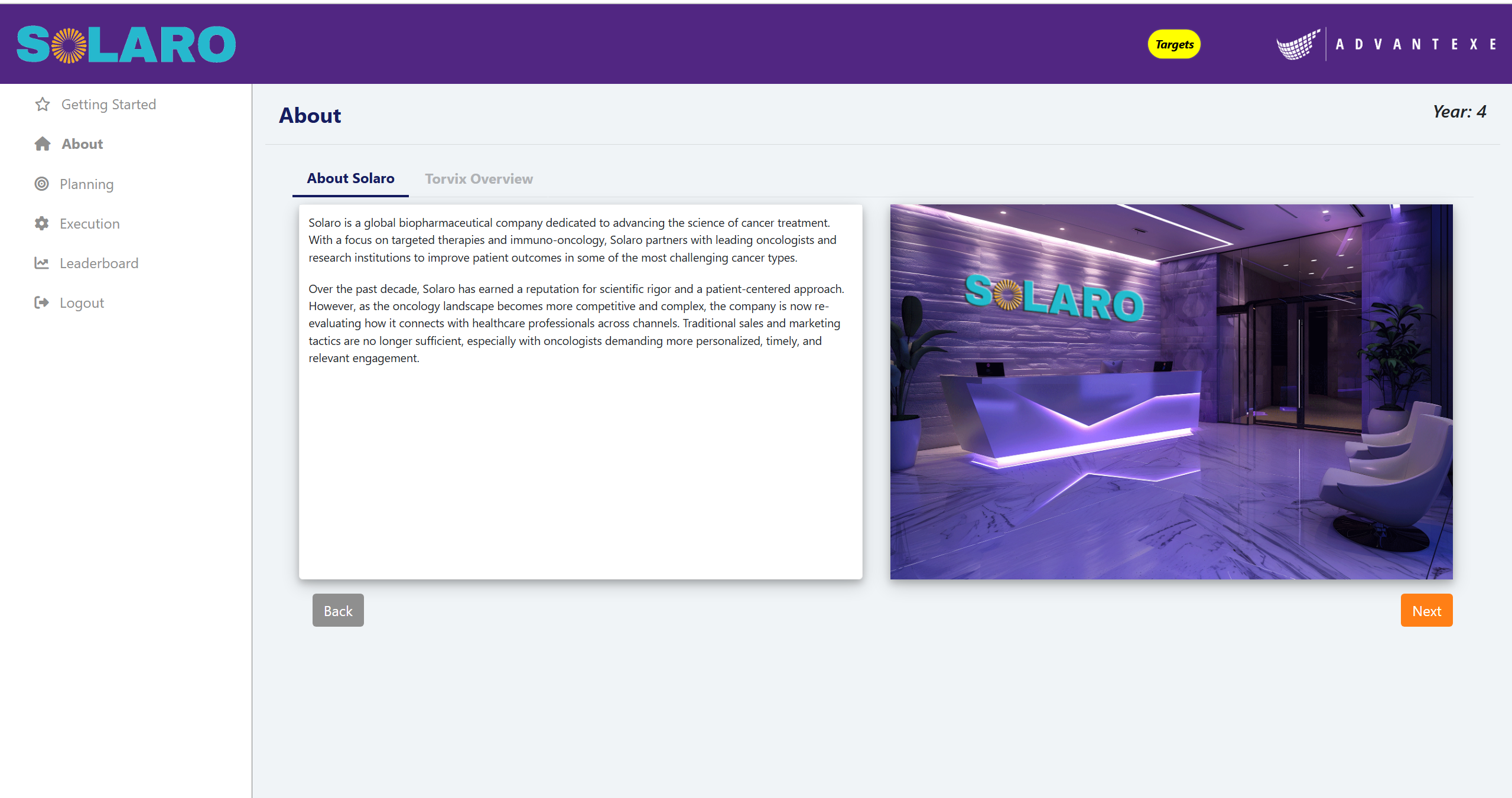
Participants applied these concepts through Advantexe’s Business Leadership Essentials digital simulation, stepping into the role of a new manager at KnightSight Security Technologies, a fictional company.
Working in teams, learners navigated eight connected episodes covering a manager’s first fourteen weeks, from taking over an established team to managing a demanding product launch.
Each team made 29 scored leadership decisions, including:
- Building credibility with a team loyal to its previous manager.
- Coaching a high performer who resented being passed over for promotion.
- Addressing a remote employee’s silence before an important deadline.
- Resolving disagreement over whether to release a flawed product.
- Engaging an experienced employee who resisted a new approach.
- Managing competing requests when the team lacked capacity to deliver everything.
How the Simulation Works
Business Leadership Essentials provides a safe environment where participants practice leadership decisions and see how their choices affect the business, their team, and their effectiveness as a leader.
The experience includes:
- A connected storyline in which relationships, pressures, and earlier decisions carry forward.
- Team discussions that require learners to consider different perspectives before committing to a decision.
- Immediate changes to simulation scores across Business Leadership, People Leadership, and Individual Leadership.
- Access to Alaix, the built-in AI coach, for guidance throughout the experience.
- Confidence checks, reflections, and written action plans that connect simulation lessons to participants’ own teams.
Each pair of episodes closes with specific commitments about what participants will do differently at work, helping translate practice into an actionable development plan.
Results
The five-team cohort demonstrated measurable progress within the simulation and identified specific leadership behaviors to apply on the job.
- 100% of teams completed all eight episodes and finished above their starting score in all three leadership dimensions.
- 80% of final team skill scores reached the Strong level. The remaining 20% reached Developing, with all scores beginning at Emerging.
- Average simulation scores increased by 30.8 points in Business Leadership, 28.0 points in People Leadership, and 27.0 points in Individual Leadership, from a common starting score of 50.
- One team’s reported confidence in addressing a high performer’s damaging behavior moved from Slightly Confident to Very Confident after completing the relevant episodes.
- Participants’ action plans included commitments to listen before directing, gather facts before drawing conclusions, involve experienced employees in change, and communicate what competing priorities would require them to delay or reduce.
- Episode-level results highlighted opportunities for further development, particularly around delegation, managing up, and balancing demands with available capacity.
Results reflect team performance within the simulation and participants’ reported confidence and action plans.
Participant Quote
“Do not jump to instructions. Understand the situation well before directing.”
Participant action plan following the episodes on taking over a team and setting expectations.