


This blog wasn’t on our radar. But all of a sudden, over the last few weeks, as our clients, leaders of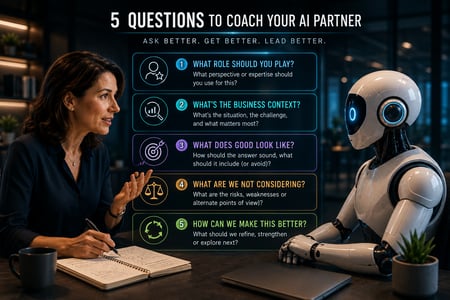 global businesses, started to move from, “Oh yeah, the thought of using AI is cool,” to “Oh damn, this is great, but it’s not what I thought,” we’ve been hearing urgent requests for business acumen and business leadership training on a very basic but very important new skill:
How do you coach your AI partner?
Not use it. Not prompt it. Not play with it.
Coach it.
Because that is the shift.
AI is not a search engine. It is not a magic vending machine where you type in a sentence, pull the lever, and out comes brilliance. It is also not some mysterious super-brain that automatically understands your company, your culture, your strategy, your customers, your politics, your priorities, or what your boss actually meant in the email that made everyone nervous.
AI is a partner.
And like any partner, it needs direction, context, feedback, correction, and coaching.
Don’t Believe the Social Media “Experts”
If you scroll through social media — and yes, you do — pretty much every other post features an “expert” telling you about their secret ChatGPT or Claude prompts, techniques, and commands.
Some of it is useful. Some of it is entertaining. Some of it is just repackaged common sense with a neon headline and a promise that you can become 400% more productive by Tuesday.
But, don’t be fooled.
Most of them are trying to sell you a subscription, build a following, or monetize their “content.” Read it. Listen to it. Learn from it. But don’t get sucked into the trap that this is all magic. It isn’t. AI will continue to evolve. It will get better, faster, more accurate, more integrated, and more useful. But for right now, there is still a lot of work to do.
And the work starts with how you coach it.
Five Foundational Things You Need to Know Right Now
1. Your AI partner isn’t perfect
AI can be incredibly helpful, but it can also be wrong, shallow, generic, overly confident, or completely disconnected from your business reality. If you treat the first answer as the final answer, that’s on you.
2. Your AI partner will continue to evolve and grow
What it can do today is not what it will be able to do six months from now. The people who win with AI will not be the ones who memorize one perfect prompt. They will be the ones who keep learning how to work with it.
3. You need to explain things in detail
AI does better when you provide context. Who is the audience? What is the goal? What is the business issue? What tone do you want? What constraints matter? What does “good” look like? If you give it vague input, don’t be shocked when you get vague output.
4. You still own the judgment
This may be the most important point. AI can help frame options, challenge thinking, summarize data, draft content, and identify patterns. But it does not own the decision. You do. Business acumen still matters. Leadership still matters. Experience still matters.
5. The best results come from iteration
The first answer is rarely the best answer. The magic is in the back-and-forth. Ask it to sharpen. Ask it to simplify. Ask it to make the argument stronger. Ask it what you are missing. Ask it to pressure-test your assumptions. That is where AI becomes a partner instead of a toy.
Five Things You Need to Start Doing Today to Coach Your AI Partner
1. Set the role before you ask the question
Don’t just ask AI to “write something” or “analyze this.”
Tell it the role you want it to play.
- “Act as a CFO reviewing this investment case.”
- “Act as a skeptical customer evaluating this proposal.”
- “Act as a senior leader preparing managers for a tough change conversation.”
- “Act as a business acumen coach helping frontline leaders understand margin pressure.”
That simple shift changes the quality of the output because you are giving the AI a lens. And in business, the lens matters.
A CFO sees risk differently from a salesperson. A customer hears value differently from a product manager. A frontline supervisor experiences change differently from an executive.
Coach the AI into the right seat before you ask it to drive.
2. Give it the business context, not just the task
Most people underuse AI because they under-explain the situation.
They write, “Create a communication plan,” and then wonder why the answer sounds like something pulled from a generic business textbook.
Instead, explain the business.
“Our margins are declining because input costs are rising, but customers are pushing back on price increases. We need managers to explain the trade-offs between price, volume, service, and profitability.” Now the AI has something to work with.
This is where business acumen comes in. If you understand the economics of the situation, you can coach the AI more effectively. You can explain the customer pressure, the financial tension, the strategic trade-off, and the leadership challenge.
AI can help you think. But you need to give it something worth thinking about.
3. Teach it what good looks like
This is the step most people skip. They ask for an output, get something mediocre, and conclude, “AI isn’t that good.”
Maybe. Or maybe you didn’t coach it. Give examples. Share style preferences. Tell it what to avoid. Explain the quality standard.
For example:
- “This needs to sound like a practical business leader, not a consultant.”
- “Make it more direct and less academic.”
- “Use shorter sentences.”
- “Add more tension.”
- “Make the customer sound more realistic.”
- “Don’t use buzzwords.”
- “Give me three versions: safe, stronger, and provocative.”
That is coaching. The more clearly you define “good,” the closer AI gets to helping you create it.
4. Challenge the answer, don’t just accept it
One of the most powerful things you can do is push back. Ask:
- “What are the weaknesses in this argument?”
- “What would a skeptical CFO say?”
- “What risks am I ignoring?”
- “What assumptions are hidden in this recommendation?”
- “What would make this fail?”
- “What is the strongest counterargument?”
This is where AI becomes extremely valuable. Not because it is always right, but because it can help you see around corners.
Too many leaders use AI as a shortcut to an answer. The better use is as a thinking partner who helps improve the quality of your decision. There is a huge difference.
5. Keep the human voice and accountability in the work
AI can draft. AI can summarize. AI can organize. AI can create options.
But you still have to lead.
You need to read the output and ask, “Does this sound like us? Does this reflect our strategy? Is this appropriate for this audience? Is this true? Is this useful? Is this something I would stand behind?” Because at the end of the day, you can’t walk into a meeting and say, “Well, ChatGPT said it.”
That won’t go well.
AI can support your thinking, but it cannot replace your credibility. It can help you move faster, but it cannot replace your judgment. It can help you create better work, but only if you stay actively involved in the work.
Final Thoughts
The next wave of AI capability will not be defined simply by who has access to the best tools. Everyone will have access to the tools.
The real advantage will belong to the leaders, teams, and organizations that know how to coach those tools into better performance.
That means asking better questions. Providing better context. Giving better feedback. Challenging the output. Applying judgment. And refusing to confuse speed with quality.
Your AI partner may be powerful. But it still needs a coach.
And for now, that coach is you.