


We’ve started noticing something interesting during our business simulation rounds.
Participants are increasingly using AI as they work through complex business decisions. That’s not surprising. AI has quickly become part of how many of us analyze information, explore ideas, and solve problems. What is interesting is how differently people use it.
Some participants take a screenshot of their simulation results, paste it into an AI tool, and ask: “What is happening here? What should I do next?”
Within seconds, AI can read the numbers, identify trends, summarize performance, and suggest a course of action. Useful? Absolutely.
But we’re also seeing participants use AI differently. Instead of asking AI to do the analysis, they develop their own interpretation first and then use AI almost like a business consultant to challenge assumptions, uncover relationships, and test their thinking.
Same Data. Two Very Different Uses of AI.
Consider an actual example from one of our business simulations. Participants run a simulated company over three years, making decisions about pricing, marketing, operations, investment, and product strategy.
One team generated these results:
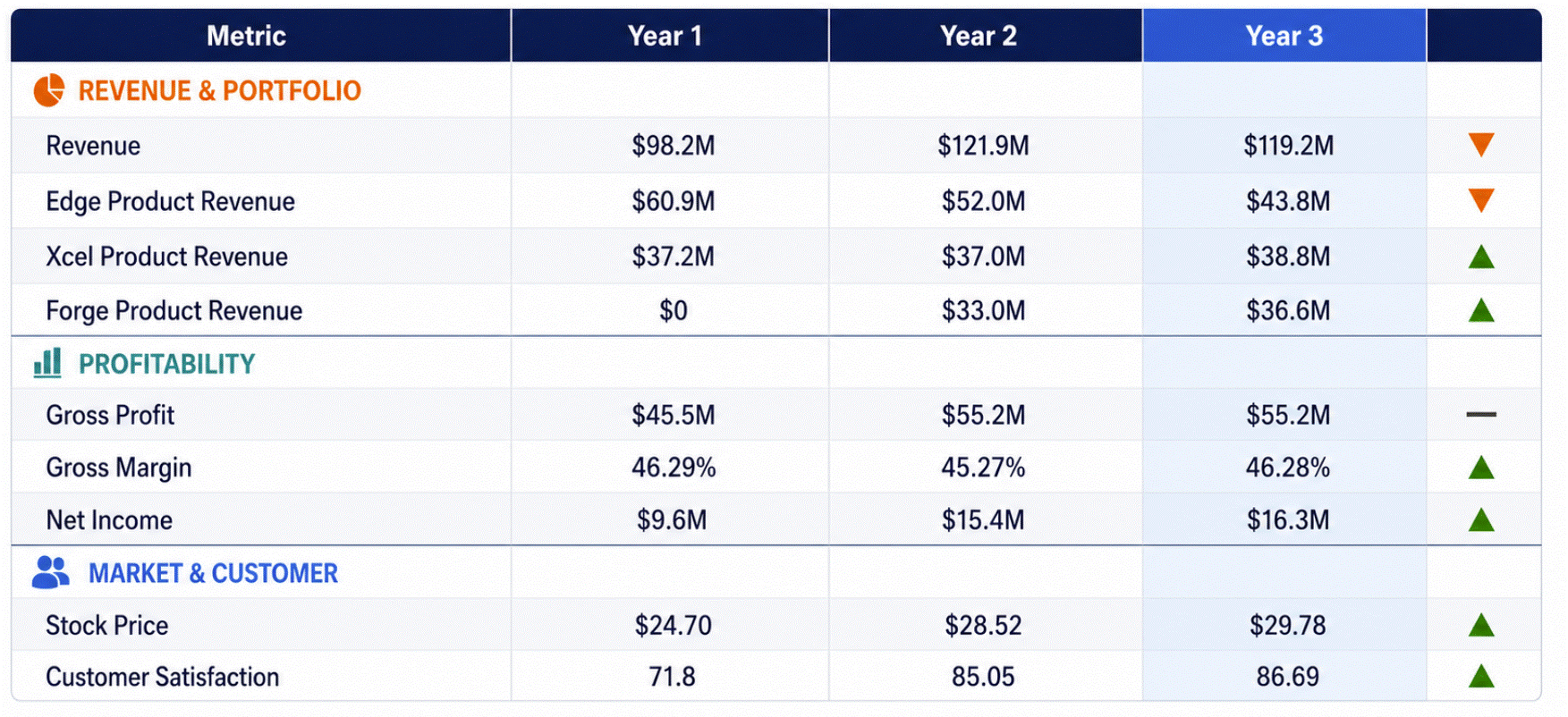
There’s quite a bit happening here. Now imagine two teams looking at exactly the same results and using the same AI tool.
Approach One: Ask AI for the Analysis
Team 1 uploads a screenshot and prompts the AI tool: “Analyze these results. How did the company perform, and what should we do next?”
AI can quickly identify that overall performance improved. Revenue grew substantially over three years, net income increased, CSAT improved, and the stock price rose. It can also recognize the shift from the declining Edge business toward the rapidly growing Forge product.
It might recommend continuing to invest in Forge while managing the decline of Edge. None of that is necessarily wrong. In fact, it’s a useful analysis. But consider a different interaction.
Approach Two: Give AI Your Thinking
Team 2 studies the results first and develops an initial point of view:
“Revenue grew significantly in Year 2 but declined slightly in Year 3. Despite that decline, net income continued to increase, and gross margin recovered to roughly its Year 1 level. At the same time, our revenue mix changed dramatically. Edge declined every year, while Forge grew to more than $36 million. CSAT and stock price also continued to improve. My initial conclusion is that we’re successfully transitioning the portfolio toward Forge and creating a more profitable business, even though top-line growth has slowed.”
Then they turn to AI:
“Act as a business advisor and challenge my interpretation. What relationships am I missing? What alternative explanations could account for these results? What risks might be hidden by the strong profitability numbers? What would you want to know before concluding that the portfolio transition is working? What should I watch most closely next year?”
The data hasn’t changed. The AI tool hasn’t changed. But the conversation has.
What Changes When We Change the Conversation?
The difference becomes clearer when we compare the kinds of insights each approach can generate.
|
Area |
“Tell Me What Happened” |
“Here’s What I Think. Challenge Me.” |
|
Performance |
Revenue grew from $98.2M to $119.2M while net income increased from $9.6M to $16.3M. Overall performance improved. |
Revenue actually declined 2.2% in Year 3, while net income increased 5.6%. What's allowing the business to generate more earnings from less revenue, and is it sustainable? |
|
Margin |
Gross margin declined in Year 2 before recovering to 46.28%. |
Margin returned almost exactly to Year 1 levels, but with a very different product portfolio. What changed in the underlying economics? |
|
Product Mix |
Edge declined while Forge grew rapidly and became an important source of revenue. |
Edge lost $17.1M in revenue while Forge added $36.6M. Is Forge generating incremental growth, replacing Edge, cannibalizing it, or some combination? |
|
Profitability |
Net income increased substantially, indicating improved profitability. |
Net income grew about 70% while revenue grew about 21%. What's driving that operating leverage, and can it continue? |
|
Customer |
CSAT increased from 71.8 to 86.7, indicating improved customer satisfaction. |
CSAT improved dramatically during the portfolio transition. Is Forge creating a stronger customer proposition, or are other decisions responsible? |
|
Risk |
The decline in Edge should be monitored. |
Edge is declining quickly, and Year 3 growth has stalled. Could strong profitability and CSAT be masking a future growth problem? |
|
Next Move |
Continue investing in Forge while managing Edge's decline. |
Before deciding, understand what's driving Forge growth, Edge's decline, and the margin improvement. The next decision depends on those answers. |
The first response isn't a bad use of AI. AI can take a complicated set of business results and quickly summarize the most visible trends.
The second conversation goes further because the participant has given AI more than data. They have given it a point of view to examine. AI can now challenge assumptions, propose alternative explanations, surface missing information, and help distinguish between what the numbers show and what we assume they mean.
That starts to look less like an answer engine and more like a business advisor. The Skill Isn't Prompting. It's Thinking.
It would be easy to conclude that the second participant simply wrote a better prompt. There is some truth to that, but it misses the more important distinction. To ask AI to challenge an interpretation, you first need an interpretation.
The participant had to recognize that revenue fell while profit increased. They had to notice the changing product mix, connect Edge's decline with Forge's growth, and question whether the company was creating new growth or replacing revenue disappearing elsewhere. They had to develop a hypothesis before asking AI to test it. Those are critical-thinking skills.
The opportunity, then, isn't to discourage people from using AI to analyze business information. Quite the opposite. AI can be a great resource for exploring relationships, testing assumptions, considering alternative explanations, and identifying questions we might not otherwise think to ask.
The distinction is where people enter the process. There is an old saying: give someone a fish, and they eat for a day; teach them how to fish, and they eat for a lifetime. The same principle applies to AI. Give AI information and ask for an answer, and it may give you a very good one. Bring your own observations, hypotheses, and questions to the conversation, and AI can help you sharpen your thinking, challenge your assumptions, and develop better ideas.
As AI becomes embedded in everyday work, that distinction may become increasingly important. The advantage may not come from knowing how to write the perfect prompt. It may come from knowing enough about the business, the situation, and the decisions behind the numbers to give AI something worth challenging.