


If you listen to enough AI conversations these days, you might start to believe that the future of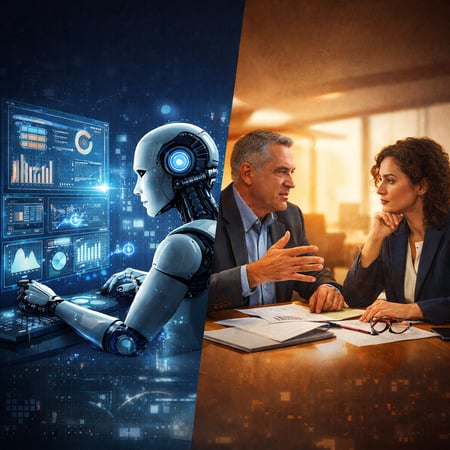 business decision-making will be entirely automated.
- Algorithms analyze the data.
- The system generates insights.
- Leaders simply approve the recommendation.
But something interesting is starting to happen in companies that are deeply integrating AI into their decision-making processes.
The more data they analyze, the more they are rediscovering something important.
Data does not replace judgment.
In fact, the explosion of data and AI-driven insights may actually make human judgment more important than ever.
In our work designing business acumen simulations for leaders around the world, we constantly emphasize that data is only one part of the decision-making process.
The real skill of leadership is knowing how to interpret the data and when to challenge it.
Here are five reasons why human judgment still plays a critical role in the age of AI.
1. Data Explains the Past, But Leaders Must Decide the Future
AI models are extremely good at identifying patterns in historical data.
That’s what they are designed to do.
But strategy is not just about the past; it’s about anticipating the future.
Markets change. Competitors launch new products. Regulations shift. Customers behave differently.
Great leaders must interpret data within the context of what might happen next, not just what has happened before.
2. Data Often Lacks the Full Story
One of the most common mistakes in business is assuming that data tells the complete story.
In reality, data usually tells part of the story.
For example:
A dashboard may show declining sales in a specific territory.
But the underlying reason could be:
- a competitor’s aggressive promotion
- a new hospital policy
- changes in insurance coverage
- or a key customer leaving the organization
AI can identify the pattern.
But human leaders must investigate the cause behind the pattern.
3. Context Matters More Than Algorithms Realize
AI models operate within the boundaries of the data they have been trained on.
But business decisions often require context that may not exist in the dataset.
For example:
- internal organizational dynamics
- political considerations inside large customers
- emerging regulatory pressure
- cultural differences across markets
Experienced leaders bring context that algorithms cannot easily replicate.
That context often determines whether a decision is wise or risky.
4. The Best Questions Still Come from Humans
AI can generate impressive answers.
But the quality of those answers depends entirely on the quality of the questions being asked.
This is one of the emerging leadership skills in the AI economy.
Leaders must learn how to ask better questions, such as:
- What insight is the data not showing us?
- What assumptions might the model be making?
- What alternative explanations could exist?
In many ways, the future of leadership will depend less on who has the best answers and more on who asks the best questions.
5. Judgment Is What Turns Insight Into Action
One of the biggest risks in an AI-driven world is analysis paralysis.
Organizations now have access to more data and insights than ever before.
But insight alone does not create results.
Someone still has to decide:
- Which opportunity matters most
- Which risk is acceptable
- Which action should be taken now
That is where leadership judgment becomes critical.
AI can inform the decision.
But leaders must ultimately make the decision.
The Real Opportunity for Leaders
Artificial intelligence is one of the most powerful analytical tools ever created.
Used well, it can dramatically improve insight, speed, and decision quality.
But leaders who believe that AI will replace judgment misunderstand the true opportunity.
The real advantage comes from combining machine intelligence with human insight.
AI can analyze massive amounts of information. Human leaders provide the context, experience, and judgment needed to interpret that information wisely.
The organizations that succeed in the AI economy will not simply rely on algorithms.
They will develop leaders who know how to think critically about the insights those algorithms produce.
Robservation
Artificial intelligence can process more data in a few seconds than most leaders could review in a week. But leadership has never been about processing information.
It has always been about judgment. In the age of AI, the leaders who stand out will not be the ones who rely most on data.
They will be the ones who know when to trust the data, and when to challenge it.