


Parking, $45. Chicken fingers and a beer, $54. Popcorn, $17.99. A slice of pizza, $24. At any other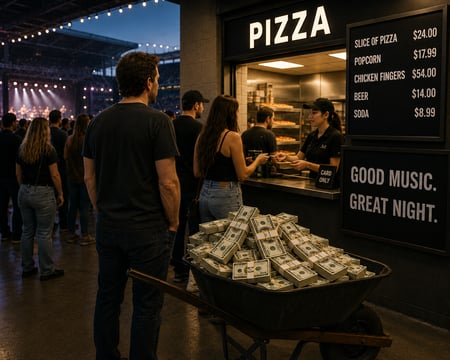 place on Earth, these prices would be outrageous.
The neighborhood pizza shop couldn't charge $24 for a slice. The local restaurant would never get away with a $17.99 bucket of popcorn. Raise prices that aggressively almost anywhere else, and customers would simply walk away.
Yet there I was at the Lionel Richie / Earth Wind & Fire concert, standing in a long line with hundreds of other fans, happily handing over my credit card.
It made me wonder...
Why do the normal rules of economics seem to disappear inside a stadium?
We've all learned about price elasticity. Raise prices too much and demand falls. Customers seek alternatives. Competition keeps businesses honest.
Except, apparently, at concerts, sporting events, airports, theme parks, and a handful of other places where people willingly pay prices they would reject anywhere else.
But here's the interesting part. The laws of economics haven't broken down. They are working exactly as they should. The context has simply changed.
And buried inside that realization are some surprisingly powerful lessons for every business leader.
Lesson 1: Customers Don't Buy Products. They Buy Experiences.
The hot dog isn't better. The popcorn isn't fresher. The beer certainly doesn't taste twice as good. What's different is what you're actually purchasing.
You're buying convenience. You're buying the ability to stay in your seat for the next inning. You're buying the shared experience of spending an afternoon with family and friends.
In other words, you're not buying food. You're buying the experience surrounding the food.
Too many businesses spend enormous energy improving products while giving far less attention to improving the overall customer experience. Customers evaluate the entire journey, not just the item they leave with.
Lesson 2: The Real Product Is Scarcity
Once you're inside the stadium, your choices become remarkably limited. You can buy what's available. Or you can wait until after the concert or game. There really isn't much in between. That's an extraordinary strategic advantage.
Business leaders often assume competitive advantage comes from having the best technology, the strongest brand, or the lowest costs. Sometimes it does.
But sometimes the greatest competitive advantage is simply creating an environment where customers have very few practical alternatives.
Software ecosystems do this. Luxury resorts do this. Cruise ships do this. Airports do this every single day. The competition hasn't disappeared. It's simply become inconvenient. And inconvenience has economic value.
Lesson 3: The Buying Decision Happened Hours Earlier
Here's the insight that fascinated me the most. I didn't decide to buy expensive food when I reached the concession stand. I made that decision the moment I purchased the concert tickets.
Once I'd committed to attending the event, I'd already invested money, time, anticipation, transportation, parking, and an entire evening. The food purchase became almost automatic.
The real sale had already taken place. The best businesses understand this. Individual purchases are often just small chapters inside a much larger customer journey.
When customers fully commit to your ecosystem, your platform, your service model, or your brand, many future buying decisions become significantly easier.
Lesson 4: Great Companies Don't Compete on Price. They Compete on Value.
Many leadership teams still default to the same discussion. "If sales slow down, maybe we should lower prices." Sometimes that's the right answer. Often it isn't. Apple isn't trying to be the cheapest. Disney isn't trying to be the cheapest. Rolex isn't trying to be the cheapest.
The stadium certainly isn't trying to be the cheapest.
Each of these organizations understands that customers are evaluating something much larger than price. They're evaluating value. The strongest companies don't eliminate price sensitivity. They reduce it by creating so much perceived value that price becomes only one part of a much larger equation.
Lesson 5: Pricing Power Is Earned
Perhaps the biggest business acumen lesson is this:
Pricing power isn't something you declare. It's something you earn. It comes from building trust. Creating differentiation. Delivering experiences competitors can't easily replicate. Reducing customer risk. Making life easier. Solving bigger problems.
The greater your value proposition, the less your customers focus exclusively on price. That's one of the reasons the world's most admired businesses often enjoy the healthiest margins. Not because they're lucky.
Because they've spent years building value that customers willingly pay for. So the next time you're standing in line wondering whether anyone should ever pay $24 for a slice of pizza, remember this:
You're not witnessing the failure of economics. You're witnessing economics working perfectly. The environment changed. The customer journey changed. The value proposition changed.
And with it, customers' willingness to pay changed as well.
Which brings me to one final question.
Does your business sell products that customers compare...or experiences they commit to?
- Because there is an enormous difference.
- Products invite price comparisons.
- Experiences create emotional commitment.
- Products compete in markets.
- Experiences create markets.
The companies with the greatest pricing power rarely have the lowest prices. They have the strongest value proposition.
And that may be one of the most important business acumen lessons hidden inside a $17.99 bucket of popcorn.