



Smarweys, one of the fictional companies Advantexe uses in our simulation-based learning experiences, reported adjusted EBITDA of $28.8 million in Q4 2025 (12.9% margin) and full-year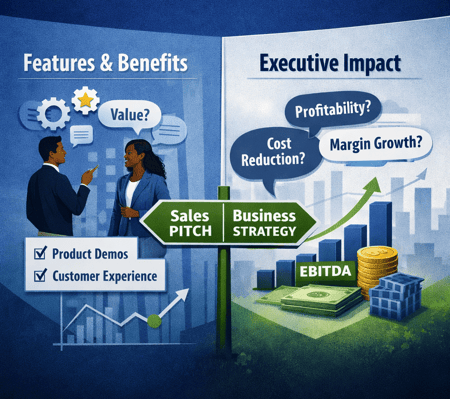 adjusted EBITDA of $145.7 million with a margin of 16.1%.
On the surface, that reads like a standard earnings update. But we use examples like this intentionally in our “walk a mile in your customer’s shoes” business acumen sales training for a reason.
Do your sales teams actually understand what that means?
Because if they don’t, they are missing how their customers really think about decisions.
What EBITDA Actually Tells You
EBITDA (Earnings Before Interest, Taxes, Depreciation, and Amortization) is a measure of operating performance. It reflects how efficiently a company converts revenue operations. What’s even better is that it is a controllable metric and one that leaders can be held accountable for.
In practical terms, EBITDA is where leaders focus when they are trying to:
- Improve margins
- Reduce operating costs
- Increase efficiency
- Drive more profitable growth
It is not just a finance metric. It is a decision-making lens.
Where Most Sales Professionals Miss the Mark
Most sales conversations still live here:
- Features
- Benefits
- Customer experience
- Price
- Price
- Price
Those matter. But they are not how executive buyers prioritize investments.
Executives are asking:
- Does this solution improve margins?
- Does it reduce cost-to-serve?
- How will this increase our revenue?
- Does it increase operating leverage?
In other words: Does this improve EBITDA?
If your sales team cannot connect their solution to that question, they are operating at the wrong level.
What This Looks Like in Practice
Take a company like Smarweys, running a 12.9% EBITDA margin in Merchant Solutions.
A typical rep might say: “Our solution improves transaction speed and enhances the customer experience.”
A more effective rep reframes the conversation: “With EBITDA margins at 12.9%, even a 1–2 point improvement has a meaningful impact on profitability. Our solution reduces processing costs and increases throughput, lowering operating expenses while driving higher transaction volume. That combination directly expands EBITDA.”
That is a fundamentally different conversation. It shifts from what the product does to how the business performs.
Why This Matters in Practice
This is exactly why we put sales professionals inside the business through simulation. They are not just learning what EBITDA means. They are running a company where decisions directly impact it. They feel the trade-offs. They see the consequences. And they practice translating those outcomes into customer conversations. That is what it means to truly walk a mile in your customer’s shoes.
The Real Gap
This is not a messaging issue. It is a business acumen issue. Sales teams are often well-trained on:
- Product Knowledge
- Competitive positioning
- Sales methodology
- Sales Process
But far fewer are trained to engage in trusted business dialogues to:
- Understand financial metrics like EBITDA
- Translate features into financial impact
- Position solutions in terms that executives care about
And that gap shows up quickly to senior buyers.
The Bottom Line
If your sales team cannot interpret a statement like: “EBITDA margin of 12.9%,” they are not equipped to have the conversation your customers want to have. And if they cannot connect their solution to improving that number, they are losing high-margin deals.