



During a recent workshop discussion about the evolution of AI, and the fear that it will take all the jobs, disrupt the economy, and redefine the future of work forever, one of the participants said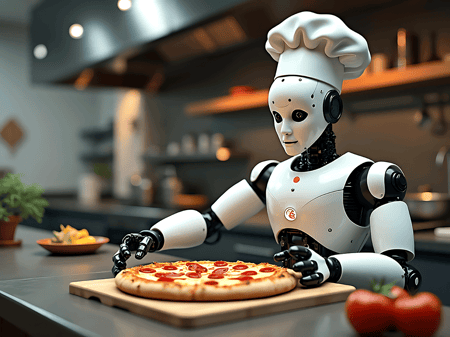 something that stopped the room cold:
“No matter what happens, your AI assistant will never eat a pizza.”
It was such a simple, almost humorous statement. But it was also profound.
He was referring to a fundamental truth about the U.S. economy: it is, and will remain, consumer-driven. And consumers—human consumers—will always be the ones eating the pizza.
AI may order it.
AI may optimize the supply chain behind it.
AI may manage the labor scheduling, demand forecasting, marketing campaigns, revenue management, and customer service interactions.
AI may even send you the perfect personalized offer at 5:32 p.m., right before you hit decision fatigue and give in to the pepperoni.
But it will never take a bite.
And that insight matters.
Because while AI is becoming indispensable to workflows, productivity, and decision-making (I myself would love to reward my AI assistant with a hot slice), the economic engine still ultimately relies on human behavior, human choice, and human consumption.
From a business acumen perspective, there are five big things today’s leaders should take away from this “AI will never eat the pizza” truth:
1) Demand Ultimately Comes From Humans, Not Algorithms
AI can stimulate demand, predict demand, or influence demand, but it cannot be demand.
This means:
- Companies must continue to understand human psychology, segmentation, and preference.
- Growth still depends on meeting human needs, solving human problems, and creating human value.
- The firms that win will use AI to amplify customer insight—not replace it.
AI creates efficiency. Humans create revenue.
2) Innovation Must Serve Human Behavior, Not Replace It
Businesses often ask, “How far can AI go?”
A better question is, “How does AI make the human experience better?”
Every great product or service innovation, even AI-driven ones, must anchor to:
- Convenience
- Emotion
- Trust
- Enjoyment
- Identity
People don’t just eat pizza to satisfy hunger. They eat it because it’s Friday, because their kids love it, because their team won, or because they had a tough day.
AI can’t feel those motivators, which means leaders must remain grounded in the human moments behind consumption.
3) Talent Shifts — It Doesn’t Disappear
AI doesn’t eliminate work. It eliminates tasks.
And the work that remains becomes more human:
- Leadership
- Creativity
- Empathy
- Judgment
- Relationship building
- Ethical decision-making
The future belongs to people who can partner with AI, not compete with it.
In other words, we don’t need fewer people; we need different capabilities in people.
4) Value Creation Will Come From Combining Human + AI Strengths
AI is extraordinary at:
- Pattern recognition
- Speed
- Scale
- Consistency
- Repetitive problem solving
Humans are extraordinary at:
- Context
- Nuance
- Imagination
- Storytelling
- Making meaning
The companies that create disproportionate advantage will design operating models where AI handles the predictable, and humans handle the exceptional.
When that happens, productivity explodes—not because AI replaces humans, but because it frees them.
5) The Economy Will Evolve, but Consumption-Driven Growth Isn’t Going Anywhere
Even with AI everywhere, economic fundamentals remain unchanged:
- People buy things
- People eat things
- People enjoy experiences
- People make emotional decisions
- People choose how to allocate their time and money
In every earnings call, every strategy session, and every simulation we run at Advantexe, one truth remains:
At the end of the value chain sits a human.
That will not change—no matter how intelligent our systems become.
Business Acumen Takeaway
Here’s the mindset I encourage every leader to adopt heading into 2026:
AI will transform how work gets done. But humans will continue to drive why the work exists.
Leaders who embrace both sides of that equation—leveraging AI for accelerated performance while doubling down on human insight, creativity, and judgment—will be the ones who win.
And yes… they’ll also be the ones eating the pizza.