

Helping employees build the business understanding and confidence to make better decisions.
Read More >Jim Brodo

Recent Posts

The Business of Baseball
At Advantexe, we often explore business and leadership topics through things that happen in our everyday lives. Sports provide plenty of opportunities. There are decisions about strategy, talent, investments, customers, revenue, managing expenses, and growth. But this week, one decision has me scratching my head: scheduling the Phillies and Braves Wild Card games at 2:00 PM.
The series is now tied at 1–1, and I missed most of the first game and the entire second game. Not because I wasn’t interested. I was working. And I’m sure plenty of fans in Philadelphia and Atlanta have been in the same situation.
As a Phillies fan, that is frustrating. As someone who spends a lot of time thinking about business acumen, it raises questions about the trade-offs behind the scheduling decision. I don’t have MLB’s financial models or audience research. Maybe the decision-makers have data that supports this approach. But does that analysis consider the full business impact, including the local engagement and spending lost when fans cannot watch?
Start with a simple question: Who can actually watch a game at 2:00 on a weekday? People are working, attending meetings, serving customers, and managing deadlines. Some will have it on in the background or check the score between calls. That was about all I could manage. Following a score is a very different experience from sitting down to watch your team compete in the playoffs.
Read More >
AI is changing jobs. But have we actually stopped to define what those jobs are becoming?
I have been thinking a lot about that question lately. As organizations rapidly adopt AI, there is tremendous focus on the technology, the tools, and getting employees to use them. But I think there is another issue that deserves just as much attention. If AI changes what people do every day, doesn't it also change what they need to be good at?
And if that's true, we may need to take another look at the competency models we use to hire, develop, evaluate, and prepare our people for what's next.
Consider a software developer. For years, a significant part of a developer's value came from the ability to write code. They understood programming languages, wrote thousands of lines of code, debugged problems, tested solutions, and ultimately turned an idea into a working product.
Read More >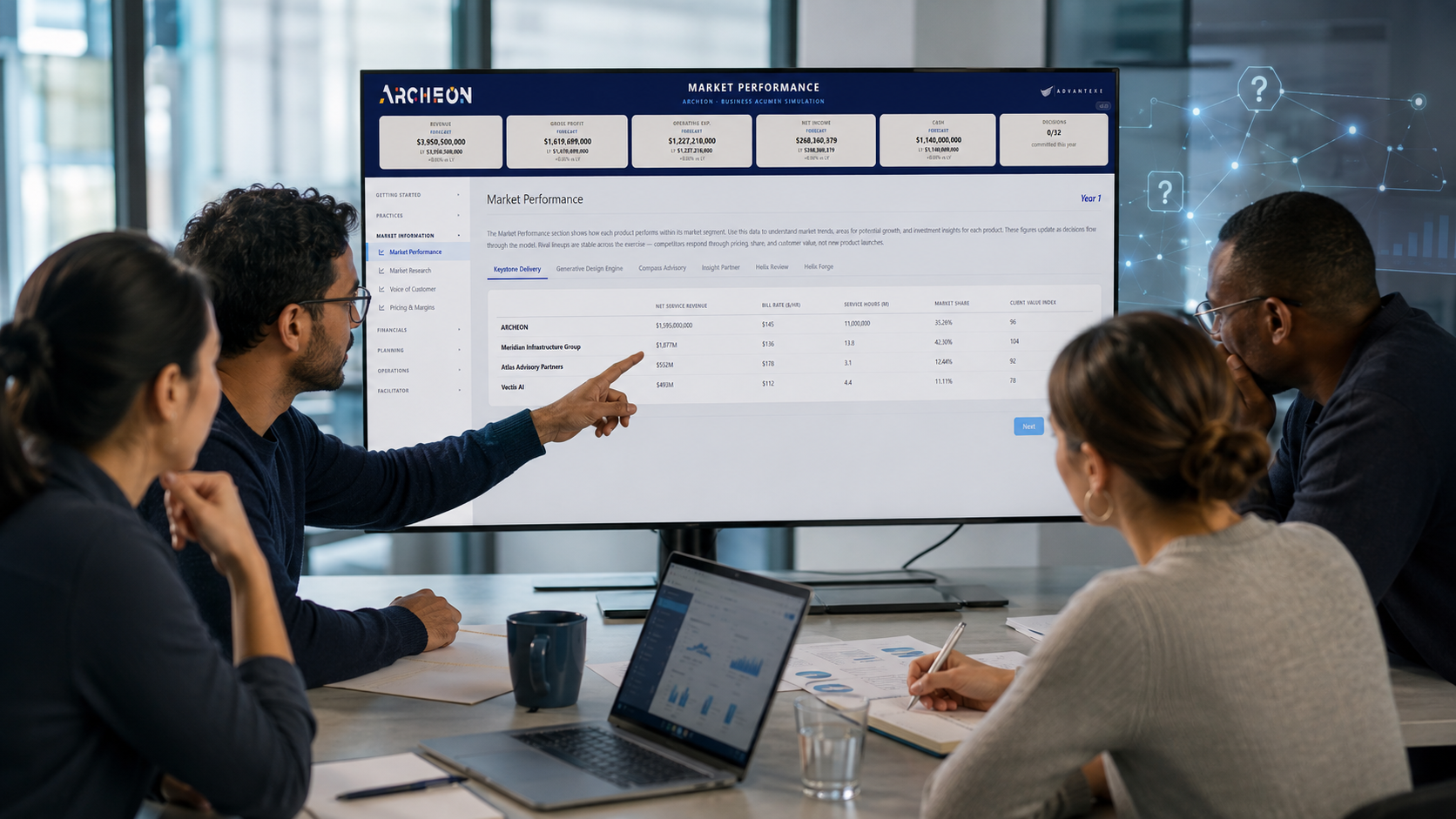
We’ve started noticing something interesting during our business simulation rounds.
Participants are increasingly using AI as they work through complex business decisions. That’s not surprising. AI has quickly become part of how many of us analyze information, explore ideas, and solve problems. What is interesting is how differently people use it.
Some participants take a screenshot of their simulation results, paste it into an AI tool, and ask: “What is happening here? What should I do next?”
Within seconds, AI can read the numbers, identify trends, summarize performance, and suggest a course of action. Useful? Absolutely.
But we’re also seeing participants use AI differently. Instead of asking AI to do the analysis, they develop their own interpretation first and then use AI almost like a business consultant to challenge assumptions, uncover relationships, and test their thinking.
Read More >
My head is still spinning from ATD in May. Everywhere you turned, there was another AI
announcement, another product launch, or another promise about how AI was going to transform learning. It was exciting, but also a little overwhelming.
A few months later, the picture is becoming clearer.
Organizations are moving beyond experimenting with AI and beginning to identify where it delivers real value. Rather than asking, “Should we use AI?” the question is becoming, “Where should we use AI first?”
As we head into the second half of 2026, here are five trends I believe will have the biggest impact on Talent Development.
Read More >