

5 Tips for Retaining Frustrated Key Talent
Read More >
As a Talent Development professional, one of the most rewarding aspects of delivering high-quality, impactful learning solutions to our clients is to hear executives discuss the impact the learning has on their bottom-line and other key business metrics.
For the past five days, the Advantexe team has been deploying a Business Acumen learning journey for the top 140 leaders of a technology company going through a significant business transformation. Like many businesses today, this company is wrestling with the strategic dilemma of balancing delivering on a value proposition to existing customers with legacy products and services while at the same time investing in and developing new digital technologies that change the playing field.
As many Talent Development professionals migrate toward new and disruptive technologies such as artificial intelligence and virtual reality, there is a legacy technology available in our learning ecosystem that still has tremendous relevance. The technology I’m referring to is called the Monte Carlo business simulation approach and this excellent tool can be used to develop specific and isolated skills in the area of business acumen better than many other learning platforms including subscriptions to meaningless eLearning libraries that are dull and linear.
Redefining the Monte Carlo Simulation Approach
The Monte Carlo simulation approach is used to conduct “what-if” analyses to understand the probabilities of different outcomes in a process that cannot easily be predicted due to the introduction of random variables, scenarios, and events. The approach can be used to identify the impact of uncertainty and probability in specific business situations.
I recently led a business simulation workshop to develop leadership skills at the University of Pennsylvania called “Designing the Future” which is part of the Master’s degree in the Nonprofit Leadership program. In the simulation workshop, we present students with a sophisticated simulation of a healthcare ecosystem set in the year 2050. Each year, the students – working in teams of 8 – must set a strategy and execute that strategy in an ecosystem of for-profit organizations, not-for-profit organizations, and government agencies.
During the fourth and fifth years of the simulation, we introduced Monte Carlo scenarios. The first scenario presented a disruption into the healthcare ecosystem to determine outcomes related to implementing a nationalized healthcare strategy. By isolating specific variables such as the number of providers, quality of providers, the health of the economy, and the quantity of healthcare provided, students learned about outcomes by tracking the various interdependencies in the system and simulation model. When we finished the workshops, we took a deep dive into the data and analyzed the outputs. In a majority of the outcomes (almost 72.3%), the overall GDP went down and the health index also went down. Based on this simulation, one could hypothesize that nationalized healthcare won’t work. But then again, it was just a learning simulation to explore leadership scenarios as well!
Monte Carlo Simulations and Business Acumen Skill Development
Employees in large companies today have very limited time for training. What used to be four-day training events have now turned into requests for 1-2 hour workshops. Seminars, lectures, and even many eLearning offerings can’t do a good job of transferring skills in that short amount of time. Monte Carlo simulations, however, are perfect for micro-learning! I am currently working on a global project for a large pharmaceutical company training their R&D leaders about business acumen. In our macro-design, we focus on how a pharmaceutical company makes money, how their pharmaceutical company makes money, and then how their decisions in R&D help their company make money.
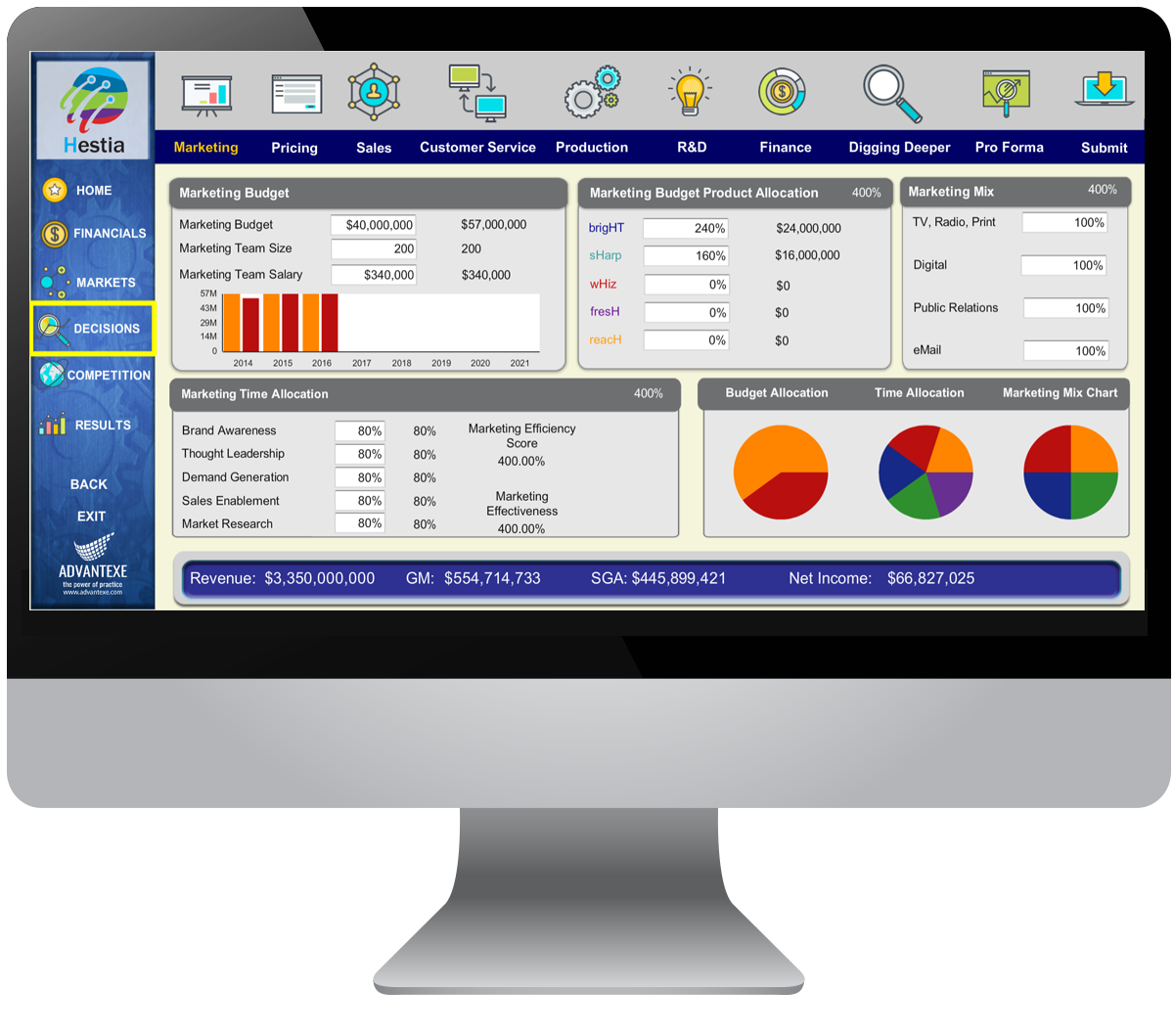
Since these R&D professionals have never been exposed to concepts of business acumen, fundamentals such as total available market (TAM), pricing strategies, marketing strategies, sales strategies, and supply chain management are not easily understood. More importantly, participants don’t understand the direct interconnections such as the relationships between marketing perception and price, quality and price, and marketing and quality. However, in a Monte Carlo-type of business acumen simulation, novices can become experts quickly by focusing on the simple interrelationships and learning how probabilities and forecasts can play out in different scenarios.
One of my favorite observations when conducting a Monte Carlo simulation scenario is when Pharmaceutical R&D leaders realize how important the investment in Marketing and Sales is to the success of the company. For example, they run scenarios where they invest in increasing levels and they watch the unique algorithms impact outcomes such as market share. The big “aha moment” is the recognition of the optimal point of each investment and the fact that even great products don’t sell themselves. They then compare the levels of investment in Marketing and Sales – in some cases 18% of revenues – to the investments in R&D (15%) to ultimately recognize how their company works and makes money.
In times of rapid and disruptive change such as we are living through in 2018 and beyond, many progressive business leaders are exploring ways of reinventing their legacy businesses so they don’t miss out on opportunities to grow, sustain, and in some cases, survive. To some business leaders, “reinvention” means a radical and disruptive evolution, and to others it means a pivot to a new value proposition and possibly a new set of customers. In my Business Acumen workshops, I often cite two different and unique examples of companies that have done both; the Kelley Blue Book, and Lego.
A Best Practice for 2018
“One of the biggest problems in my company right now is that too many of our core employees simply don’t understand how business works let alone how our business works. Forget all of the forecasts about disruptive technologies and artificial intelligence; how about basic business skills?”
--- Chief Learning Officer, Fortune 500 Company
This quote came from a conversation on the day after Christmas with a long-time client who was expressing his frustrations with the current business environment and his perception of the state of talent in his and other organizations. As I shared during our dialogue, I don’t think he’s alone. Based on many similar formal and informal conversations, I feel that many organizations are struggling with the same issue and they become accentuated at the start of every new year when leaders start to put together their plans for the coming year. Below are some observations about the challenges ahead in 2018 and some easy actions that can be taken to solve the challenges.
