Which Business simulation is right for your training programs?
As you explore the world of business simulation, there are dizzying arrays of educational choices. Much has been written about different types of simulations. Some are good for long-term exploration of complex business problems, while others are focused on a specific skill acquisition. This article will review four critical characteristics that can make up the best business simulator including technology, realism, response and feedback, and process and outcome focus.
Technology
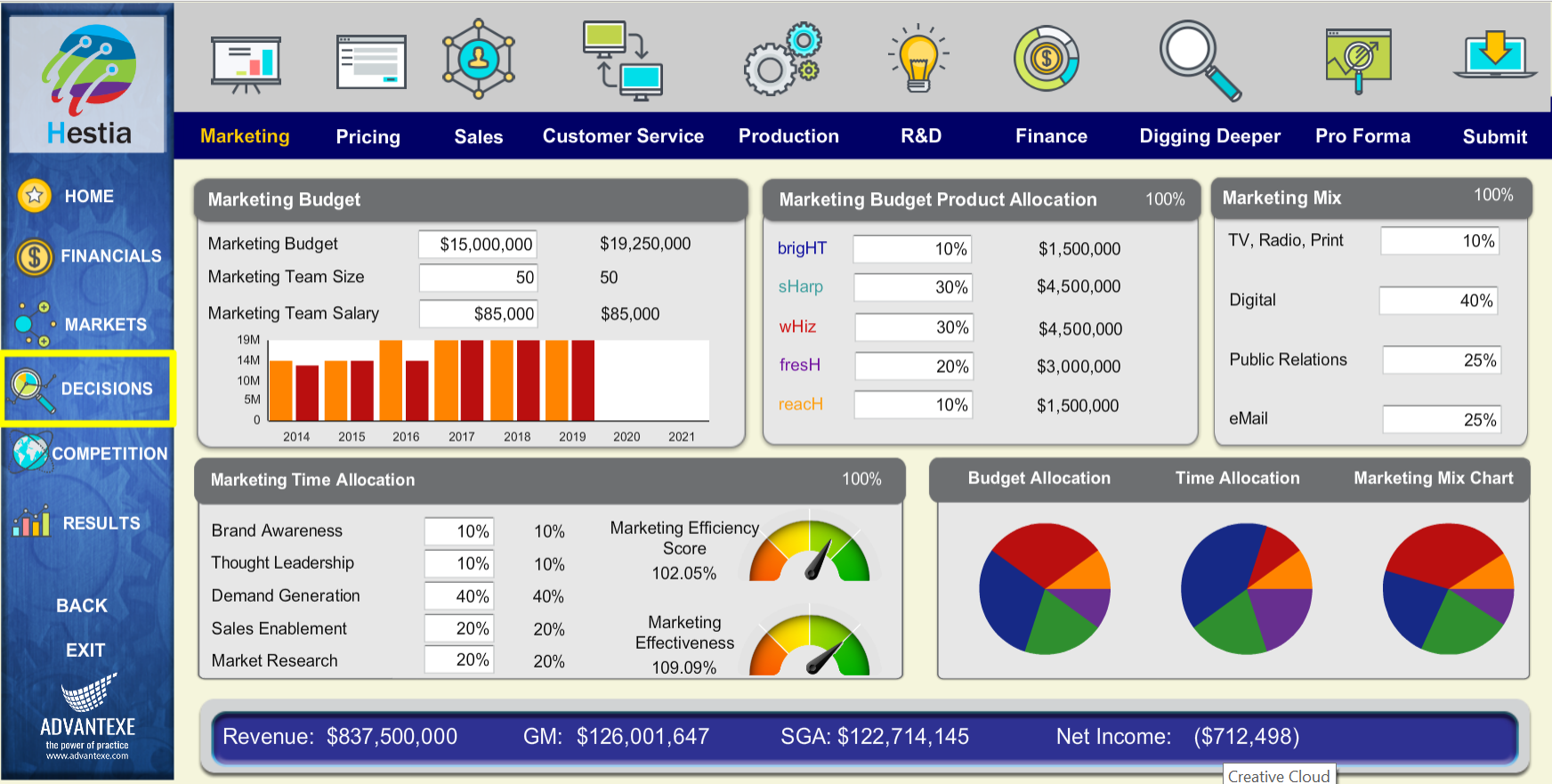
While simulations can be board-based and be effective, the focus here will be on business simulations using technology. This does not mean the simulation is necessarily online (though many are) but it does imply the users are interacting in a computerized enhanced environment. Simulations that use technology offer two major distinctive advantages to paper-based simulations, the ability to visualize the learning and the ability to gather data about the participants using the simulation. Data visualization is particularly important in more complicated simulation forms as the amount of information and variables is too much for a learner to track. The ability to personalize the simulation and use data analytics are key to making the experience interactive and measuring the effectiveness of the intervention. {Click here to learn more about Advantexe’s Zodiak Pro Simulation}
Realism
Unlike role-plays and case studies, the ability to replicate the fidelity of the external situation facing the participants within the simulated environment is key. The more life-like the simulation and the behaviors required to be successful, the more likely the learners can apply these same behaviors back on the job. Aspects of realism include things like: time constraints, budget constraints, dealing with multiple stakeholders with competing agendas, information overload, business strategy, crisis situations, etc. However, realism taken to its extreme may overcomplicate the simulated learning environment causing too much distraction and not the appropriate application. The best business simulations are designed to balance realism from hyper-realism.
Response and Feedback
Along with creating a realistic context, immersive simulations respond to the various inputs done by the participants (immediate) and are provided feedback (usually delayed as a result). This cycle of input-reaction-feedback forms the basis of the simulation engine. Inputs are characterized by financial decisions, dialogue with real/virtual participants, question choices. Some examples of reaction responses include visual prompts, trend lines, and financial calculation indicators (e.g. budget changes). Participants should be able to “see” how their inputs affect the various responses in real-time. Feedback usually comes at the end of the simulation and is an encapsulation of the work done in a round or segment. Some examples include heat maps, leaderboards, financial spreadsheet reports, and live presentations.
Process and Outcome-focused
Simulation-based learning is both about the learning process and the result. The process typically involves dialogue, competition, and cooperation and is driven by the participant's actions. Process-driven learning typically spills outside the borders of the simulation and creates opportunities for real interactions. Good learning processes typically involve other learners, business leaders, subject matter experts, and sometimes, external observers. Outcomes are contextual and can be evaluated in different ways:
- Intrapersonal (did the participants learn anything about themselves?)
- Interpersonal (were the participant able to cooperate, network, and build relationships?)
- Business (did the participants create value?)
- External (did the participants see how their decisions fit into the broader context of the industry and the community?)